August 4 - September 29, 2025 - Cedar City Public Library
Science and art might seem like polar opposites. How could method inspire creativity? Being the daughter of an anatomy/chemistry/biology teacher and an artist, I have always seen an overlap between the two.
Science is all about experimentation and exploration, and so is art. Science observes the natural world, and art highlights the beauty of the natural world. Color mixing theory, glazing and firing ceramics, developing film photography, or even art conservation are all informed by science. Printmaking in particular combines art and science in unexpected and exciting ways.
Back in January of 2025, I did a 3 week residency at Saltgrass Printmakers Studio in Salt Lake City, focusing on experimenting with various printmaking techniques. I also explored scientific subject matter like natural textures, microbiology, and anatomy. This exhibition showcases the work I did while at that residency, and how I’ve expanded on those themes and ideas since then.
The anatomical diagrams of the different types of printmaking, digital zines, and the materials in the display cases are all learning tools to help you discover the science and art of printmaking. Also included in this exhibition are projects I have started, to help those around me discover the artist within themselves through printmaking.
Etching is a type of intaglio printmaking, and is very much a science and an art form – you coat your copper plate with various mixtures to only expose certain areas of copper. When placed in acid, the exposed areas are eaten away by the acid, creating grooves or pits in your plate. Ink is deposited into the grooves and picked up by your paper to create the final print. During my residency, I experimented with different mixtures and techniques to coat my plates, create patterns, and etch my designs. Techniques I used include: hard ground, white ground, soap ground, aquatint, and line etch.
To learn more about intaglio and etchings, read the “What is intaglio?” and “What is an etching?” zines.

Anatomy Of An Etching
Copper etching utilizing white ground, aquatint, and line etch techniques
Completed during residency, January 2025


GROUND EXPERIMENTS
Between
2 plate copper etching utilizing soap ground
Completed during residency, January 2025
Growth
2 plate copper etching utilizing white ground and aquatint
Completed during residency, January 2025
Reticulation
Copper etching utilizing white ground and aquatint
Completed during residency, January 2025
AQUATINT
3 Ring Binder
Copper etching utilizing aquatint and Chine Collé
Completed during residency, January 2025
This etching was a practice in aquatint to get a range of values/grayscale. It also utilizes Chine Collé, a technique where you layer/collage a colored piece of paper into your print during the printing process. The design comes from the wrinkles of an old plastic three-ring binder.

Though this didn’t turn out how I had hoped, it was a good lesson on the scientific method. I hypothesized how to get a certain result, experimented and tested different combinations of techniques and materials, and compared the outcomes. When things went wrong, I tried to pinpoint which variable I needed to adjust and how to adjust it. Printmaking is just a big science experiment!
I enjoy the challenge of recreating textures using different media and techniques. For these etchings, I used aquatint to recreate marble and wood inlay patterns. Patterns from nature are a major source of inspiration for my artwork.
The Eye of Carrara
Copper etching utilizing aquatint
Completed in 2016, reprinted during residency, January 2025
The Viennese Knot
Copper etching utilizing aquatint
Completed during residency, January 2025
Fossilized
Copper etching utilizing white ground, hard ground/line etch, and aquatint
Completed during residency, January 2025
This print incorporates all the etching techniques I experimented with during my residency. The imagery is inspired by fossilized coral, as well as cellular/microscopic patterns.
Tools, materials, and processes of intaglio/etching that were in a display case next to the artworks


Hard ground
Aquatint test strip
Tarlatan/cheese cloth
Etching needle
White ground
A large part of my residency was trying a new-to-me printmaking process called collagraphs, where you collage various materials and textures to create your printing plate. Inspired by microscope slides, I enjoyed the challenge of creating cellular/microbiological imagery using textures like lace, crepe paper, painters tape, and ribbon.
Textural Microbiology I - V
Collagraphs using modeling paste, lace, ribbon, tissue paper, drawing paper, Elmer’s Glue, scrap metal, painter’s tape, and string.
Completed during residency, January 2025


The collagraph plates used to create these prints, and the different materials used to make the plates were in a display case next to the artworks.


Paper hole punches
Scrap metal
Tissue paper
Lace
Elmer's Glue
Ribbon/trim
Also known as screenprints or serigraphs, this process uses a screen made out of silk-like fabric stretched tightly over a frame. Areas are masked off to create a stencil. Ink is scraped across the stencil, passing through the open areas of screen onto paper or fabric underneath.
For these silkscreens, I used a photo emulsion coating (a light sensitive mixture) on my screen. I exposed my design onto the screen using a light unit (a box with very bright lights) and transparencies of my design. Areas not covered by my design were exposed to light, causing a chemical change in the emulsion and making it harden. Areas covered by my design were blocked from the light and did not harden. When the screen is washed out, hardened areas stay put while the soft areas wash away, revealing my design as open screen for ink to pass through.
To learn more about the silkscreen process, read the “What is a silkscreen?” zine.

Anatomy Of A Silkscreen
Silkscreen with 6 color layers
2025
This display case showed each layer of the multi-color silkscreen print process

This is the beginning of a series of prints (both silkscreens and linocuts) using ribcages as inspiration, reinventing them to represent different seasons throughout the year. Using anatomical subject matter, especially ribcages, has been a fun creative challenge; I have to think about composition, positive and negative space, and how to imply other imagery while not losing the integrity of the ribcage shape.

I Love You A Skele-Ton
Linocut
2025

Seasons of Change
Linocut with blend roll
2024

Spine Tree
Silkscreen with 3 color layers
2025

Relief printing is any process where you carve a material, then apply ink to the surface/high areas to print your image. The carved/low areas are not inked and become the negative space. Traditionally, blocks of wood or pieces of linoleum are used, which is where the terms “woodblock prints” or “linocuts” come from. I use a softer rubber which is an easier-to-carve alternative to linoleum.
To learn more about relief printing, read the “What is a relief print?” zine.
Anatomy Of A Linocut
Linocut with Chine Collé
2025
The different tools and materials used in relief printing/linocuts in a display case next to the artworks


Linoleum plate
Carving tool
Soft rubber plates
Brayer (roller)

Started in 2007 by Robynn Smith in California, “Print Day in May” is now a worldwide event that happens on the first Saturday in May every year, connecting printmakers everywhere and celebrating the art of printmaking. This year, I hosted a “Print Day in May” party to share my passion for printmaking with my neighbors and friends. We carved pink erasers to make mini linocut prints. A wide range of ages and levels of printmaking experience were in attendance. Here are all the beautiful creations that came out of that event!
To learn more about “Print Day in May”, go to https://printdayinmay.com/
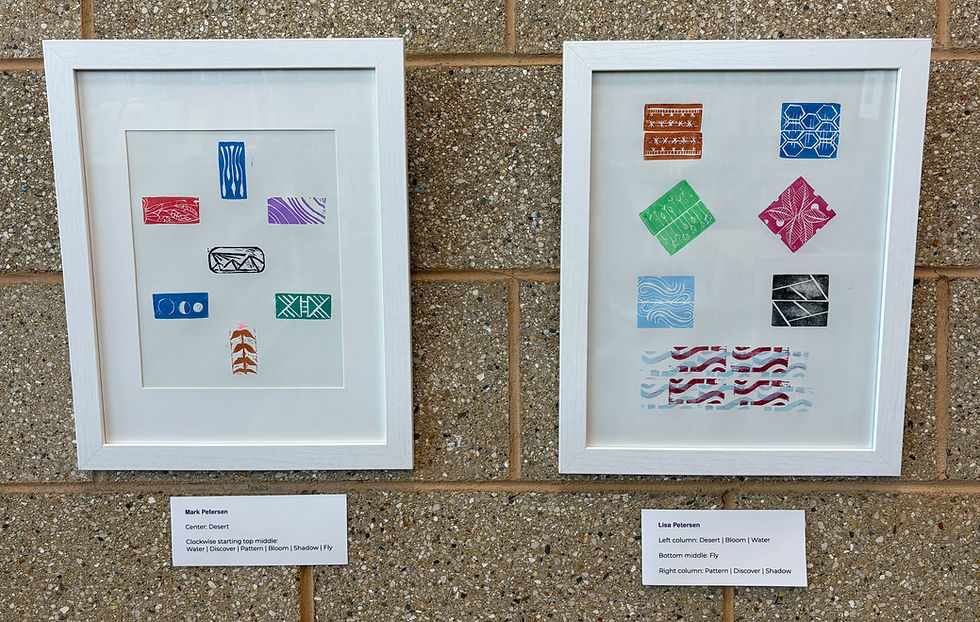
This year, I also launched a printmaking challenge to encourage people to be more creative and explore the world of printmaking. Anyone was welcome to join in. Starting on July 7, we created one mini linocut each day for 7 days.
Each day had a prompt to inspire the design
7/7: Pattern
7/8: Desert
7/9: Fly
7/10: Water
7/11: Discover
7/12: Bloom
7/13: Shadow
On display were some of the participants’ mini prints from the challenge. Some even did multiple designs for the different prompts.